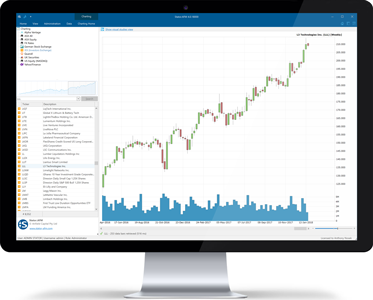
Fundamental analysts are faced with a daunting task whenever they set out to find investment candidates. To research and sift through fundamental information such as annual reports, new stories, earnings forecasts and analysts recommendations can be a very time consuming proposition.
With the aid of technical analysis a fundamental analyst can streamline this process to filter suitable investment candidates. As previously mentioned a technical analyst using a top down approach to filter out suitable trading candidates based upon a certain criteria. This same approach can be utilised by a fundamental analyst.
Why the price is a suitable indicator
The majority of fundamental analysts search for long-term investment candidates. The most simple technical indicator of a possible long-term candidate is a steady appreciation in the price of the security.
Securities markets are said to exhibit three forms of efficiency in the way information is disseminated to all market participants, weak form, semi-strong and strong. Market efficiency means simply that the more efficient the market, the greater degree that security prices reflect all the information available which may influence the price of the security. If all the information available is reflected in the price of the security then the securities price would be the most suitable technical indicator to use.
With this in mind, it is clear that a security which has sound fundamentals should experience a steady appreciation in price, as all the information is reflected positively on the security. Using this methodology a fundamental analyst can use technical indicators (i.e price) to filter out only those securities which experience a steady appreciation in price.
After the filtering process a fundamental analyst is left with a list of candidates which can then be used for further analysis.
Examples of filtering methods
Filtering methods which you may like to try include:
Rate of change calculations based upon the price of the security. For example, you should compare the moving average of the price for today against the moving average of the price for x periods in the past. This will screen out those securities which have experienced a steady increase in price over the periods nominated.
Relative strength calculations can be used to determine the strength of a security against a nominated index or another security. This method is useful to determine the strongest performing securities against a standard index. Once again the strongest performing securities would be the ones requiring further analysis. |